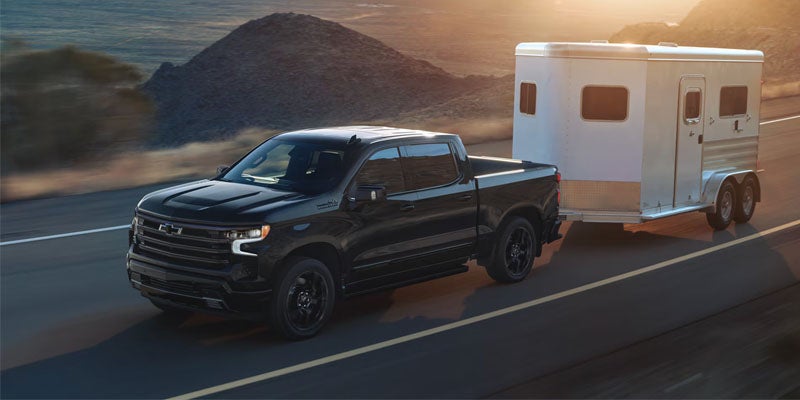




2026 Chevy Silverado towing horse trailer. Photo: Chevrolet. As the snow recedes from the Wind River Mountains, our team begins to see a shift in the service bays. Local drivers start trading winter tires for all-season rubber and bringing in their trucks to ensure they are ready for the heavy demands of hauling campers and boats. Wyoming’s summer outdoor season is rugged, and the steep grades leading out of the valley require more than just a functional hitch. A proper spring inspection focuses on the cooling system, brake pad thickness, and the integrity of the electrical connections for your trailer. Before you head out toward the scenic overlooks or hidden fishing spots, it is vital to verify that your vehicle hasn't suffered from the winter's salt and sub-freezing temperatures. We recommend a thorough undercarriage wash followed by a close inspection of the hitch receiver for any signs of corrosion or hairline fractures. If you are unsure about the condition of your equipment, you can find our Riverton location easily for a professional multi-point inspection. Our certified technicians check the transmission fluid and differential oil, both of which work significantly harder when you are pulling several tons up a mountain pass in July heat. The transition from winter commuting to summer towing also means checking your trailer wiring. Rodents often seek shelter in vehicle undercarriages during the cold months, and chewed wires can lead to lighting failures or trailer brake malfunctions. Testing your 7-pin connector now prevents a frustrating delay on the Friday afternoon you’re trying to leave town. For a quick consultation on the best towing accessories for your specific model, give us a call at (307) 240-3110 to speak with our parts specialists. Table of Contents Understanding Your Vehicle’s Specific Towing Capacity and Limits Evaluating the Silverado 1500 Powertrain Lineup Comparing Efficiency: Duramax Diesel vs. Gasoline Power for Mountain Grades Mechanical Maintenance for High-Altitude Summer Driving Tire Pressure and Equipment Safety for Heavy Camper Loads Common Questions About Summer Towing Preparation Readying Your Truck for the Wyoming Road Understanding Your Vehicle’s Specific Towing Capacity and Limits When helping a customer determine if their truck can handle a new fifth-wheel camper, the first place we look is the driver-side door jamb. Every Chevrolet Silverado 1500 and GMC Sierra comes with a Trailering Information Label that is specific to that exact VIN. This label is far more accurate than a general brochure because it accounts for the specific options, cab configuration, and bed length of your vehicle. It lists the GVWR, GCWR, and the maximum tongue weight, which is typically 10% to 15% of the loaded trailer weight for conventional hitches. It is a common misconception that every half-ton truck can pull the maximum advertised weight. For example, while the Chevrolet Silverado 1500 is rated to tow up to a maximum of 13,300 pounds when properly equipped, achieving that figure requires either the 3.0L Duramax Turbo-Diesel or the 6.2L V8 engine paired specifically with the Max Trailering Package. Understanding the difference between "dry weight" and "loaded weight" is perhaps the most critical part of towing safety. A camper might have a catalog dry weight of 6,000 pounds, but once you add full water tanks, propane, camping gear, and food, you could easily be approaching 7,500 pounds. Our team always advises customers to calculate their needs based on the fully loaded weight to ensure they stay safely within the engineering margins of their truck’s suspension and braking systems. Evaluating the Silverado 1500 Powertrain Lineup The Silverado 1500 features four distinct engines designed to match different driving and towing profiles. Rather than a single standard engine, configuration baselines shift depending on the trim level you select. Standard and Available Powertrains by Trim Trim Level Standard Engine Available Engine Upgrades Standard Drivetrain Max Seating Work Truck (WT) 2.7L TurboMax™ I4 5.3L EcoTec3 V8 2WD (4WD Available) 6 Custom 2.7L TurboMax™ I4 None 2WD (4WD Available) 6 Custom Trail Boss 2.7L TurboMax™ I4 5.3L V8 / 3.0L Duramax® Diesel 4WD Standard 6 LT 2.7L TurboMax™ I4 5.3L V8 / 3.0L Duramax® Diesel 2WD (4WD Available) 6 RST 2.7L TurboMax™ I4 5.3L V8 / 6.2L V8 / 3.0L Diesel 2WD (4WD Available) 6 LT Trail Boss 2.7L TurboMax™ I4 5.3L V8 / 6.2L V8 / 3.0L Diesel 4WD Standard 6 LTZ 5.3L EcoTec3 V8 6.2L V8 / 3.0L Duramax® Diesel 2WD (4WD Available) 5 High Country 5.3L EcoTec3 V8 6.2L V8 / 3.0L Duramax® Diesel 2WD (4WD Available) 5 ZR2 3.0L Duramax® Diesel 6.2L EcoTec3 V8 4WD Standard 5 Note: Models equipped with front bucket seats and a fixed center console (standard on LTZ, High Country, and ZR2; optional on LT and RST) drop maximum seating capacity from 6 down to 5. Estimated Starting MSRP Baselines Pricing varies by cab configuration (Regular, Double, or Crew Cab) and bed length. Work Truck (WT): Starting around $37,000 Custom: Starting around $43,600 LT: Starting around $47,900 RST: Starting around $51,500 Custom Trail Boss: Starting around $52,900 LTZ: Starting around $57,700 LT Trail Boss: Starting around $58,800 High Country: Starting around $62,700 ZR2: Starting around $70,000 The 5.3L V8 remains a staple for many Riverton families because it balances daily drivability with respectable capability, delivering a maximum towing capacity of up to 11,300 pounds depending on configuration. Even base models come equipped with standard safety tech, while upgrading to upper trims unlocks the available In-Vehicle Trailering App. This software allows you to create custom trailer profiles, track mileage, and run solo trailer light tests. When paired with up to 14 available camera views—including a "transparent trailer" view—navigating tight boat ramps or campgrounds becomes stress-free. Comparing Efficiency: Duramax Diesel vs. Gasoline Power for Mountain Grades Choosing your engine often comes down to where and how you tow. While some competitors rely on complex V6 hybrid systems, the 3.0L Duramax Turbo-Diesel remains a distinct favorite for long-haul mountain trailering due to its high low-end torque (495 lb-ft) and remarkable efficiency. EPA-Estimated Fuel Economy Ratings (By Engine & Drivetrain) Engine Option Transmission City MPG Highway MPG Combined MPG Recommended Fuel 2.7L TurboMax™ I4 (2WD) 8-Speed Auto 18 21 19 Regular Unleaded 2.7L TurboMax™ I4 (4WD) 8-Speed Auto 17 20 18 Regular Unleaded 5.3L EcoTec3 V8 (2WD) 10-Speed Auto 16 21 18 Regular Unleaded 5.3L EcoTec3 V8 (4WD) 10-Speed Auto 16 19 17 Regular Unleaded 6.2L EcoTec3 V8 (4WD) 10-Speed Auto 15 20 17 Premium Unleaded 3.0L Duramax® Diesel (2WD) 10-Speed Auto 23 29 26 Ultra-Low Sulfur Diesel 3.0L Duramax® Diesel (4WD) 10-Speed Auto 22 26 24 Ultra-Low Sulfur Diesel The diesel engine maintains steady highway momentum on steep inclines without the constant gear-hunting or high-RPM roaring common to gas engines. Furthermore, the Duramax benefits from an integrated exhaust brake. This system uses engine backpressure to help control deceleration on long downhill stretches, drastically reducing heat buildup and wear on your traditional brake pads. Mechanical Maintenance for High-Altitude Summer Driving Does your truck’s coolant look like it is ready for 90-degree days at 5,000+ feet of elevation? High-altitude driving naturally puts more strain on the cooling system because thinner air is less efficient at dissipating thermal energy. We recommend verifying a clean 50/50 mix of DEX-COOL coolant and deionized water to ensure your engine stays within safe operating temperatures. This specific ratio provides the necessary boil-over protection and prevents internal scale corrosion when the engine is under heavy load. Beyond the radiator, the transmission is highly vulnerable during summer towing. Excessive heat degrades transmission fluid properties; once the fluid overheats, it loses its ability to lubricate and protect internal clutches and gears. If you haven't had a transmission fluid service in the last 30,000 to 45,000 miles and you plan on heavy towing this summer, now is the time for a check-up. The dirt roads and rugged terrain around Lander can also be incredibly punishing to filtration systems. A clogged engine air filter starves the engine of oxygen—which is already in shorter supply at high altitudes—leading directly to decreased pulling power and poor fuel economy. Tire Pressure and Equipment Safety for Heavy Camper Loads Properly inflating your tires is the simplest way to prevent a dangerous roadside blowout. When your truck is unladen, you should follow the standard PSI inflation metrics listed on your driver-side door placard. However, dropping a heavy trailer tongue weight onto the rear hitch subjects the rear tires to maximum structural stress. You must adjust your rear tire pressures to handle this added load, often inflating them to the maximum "cold" PSI listed directly on the tire's sidewall. Remember to lower them back to placard baselines once the trip is over to avoid centering tread wear. For trailers weighing over 5,000 to 7,000 pounds, a weight-distributing hitch is highly recommended. This equipment uses spring bars to distribute tongue weight off the rear axle and share it evenly with the truck's front suspension. This levels the stance, preserves vital front-wheel steering traction, and ensures your headlights remain focused on the dark road rather than aimed up into the trees. Safety also extends to your trailer's tires and bearings. Trailer tires often sit stagnant for months, making them highly prone to dry rot and flat-spotting. Always check the manufacturing date codes on your trailer tires; if they are more than five to six years old, they should be replaced regardless of visible tread depth. Greasing the wheel bearings annually is another non-negotiable spring task that prevents catastrophic hub failures on the highway. Common Questions About Summer Towing Preparation Q: Where can I find the most accurate towing capacity for my specific Chevy truck? The most reliable source is the unique Trailering Information Label located directly on your driver-side door jamb. This calculates ratings explicitly by your vehicle's VIN, factoring in the exact cab configuration, optional equipment, and axle ratios. Q: How much can a Silverado 1500 tow if it has the 5.3L V8 engine? Depending on your exact cab configuration, bed length, and whether your vehicle features the Max Trailering Package, a 5.3L V8 Silverado 1500 can tow a maximum of up to 11,300 pounds. Q: Is the Duramax diesel better than a hybrid system for mountain towing? Q: What is the recommended coolant for a Chevy truck used for heavy summer towing? General Motors specifies a 50/50 mix of DEX-COOL coolant and deionized water. This combination optimizes the boiling point and prevents internal component corrosion under extreme thermal loads. Q: Should I change my tire pressure when I hook up my camper? Yes. To safely support heavy tongue weight and prevent excessive sidewall flexing, the truck's rear tires should typically be inflated closer to the maximum "cold" PSI rating stamped on the tire sidewall. Always return them to the door-jamb placard specifications when driving empty. Readying Your Truck for the Wyoming Road Preparing for the summer outdoor season in Wyoming requires a proactive approach to vehicle maintenance. Whether you are hauling a horse trailer through the valley or taking a large camper up into the mountains, ensuring your Chevy is mechanically sound is the key to a stress-free trip. By focusing on the cooling system, verifying your towing limits, and adjusting your equipment for the specific terrain, you can enjoy everything our region has to offer with total confidence in your vehicle’s capability. Our team is here to support your summer adventures with expert service and the right parts for every job. From hitch installations to transmission cooling upgrades, we have the experience to keep your truck running strong. If you have questions about your vehicle's readiness or want to see the latest trailering technology in person, stop by our Riverton showroom or give us a call at (307) 240-3110. We look forward to helping you get ready for another great season on the Wyoming road. © Fremont Chevrolet GMC Riverton. All rights reserved.